
Dear Google, could you please eliminate the stupid goldfish attention span myth?
I know the myth is a great supporting argument of the way you display results. But honestly. If the attention span of human would be only 8 seconds, one could read google results to know everything one needs to know about the world. Hopefully this is not the vision you aim for.
Best, Manfred
It’s like Groundhog day. The myth of the goldfish and human attention spans is still alive and every now and then someone, who mostly wants to sound smart, uses the comparison. Guess only few people ever thought about what they were talking about.
Working as a lecturer at a design college and being in charge of some bachelor students to finish their final thesis, I noticed that there’s an increase in using wrong facts as given facts. The example of the goldfish is a great example, as it shows the trap our little bully, the Search Engine, offers for us.
The myth i am talking about states that the attention span of humans is lower than the attention span of a goldfish.
Trapped by Search engines
My top result on each tested search engine (tested on Google, ecosia and duckduckgo) with the term "human attention span 2021” was an article from Ranieri x Co. They followed all current available recommendations on how to write a proper SEO headline; their title: "Changing Attention Span and What it Means for Content in 2021”.
In the beginning of their article they refer to “a recent study by microsoft” that concluded that the human attention span has dropped to eight seconds (ok, “recent” for an article from 2021 referring to a study from 2015 doesn't match. As there’s no further reference to the source, the reader won’t know the study and the underlying truth). With that easy picture of a goldfish in mind, the reader could read more about more recent results from studies around findings from videos and other content formats (all other studies link to the source). So all in all the article looks trustworthy.
The problem. People keep the information of the goldfish as a fact. It is so memorizable, so they reuse this picture of the goldfish to form their own arguments.
And I hate it. I hate the bloody goldfish.
Having an own career background in an advertising network, one gets used to some terms that are trendy for a blink of an eye and many phrases that are used to sell own arguments. But why on earth are our search engines so wrong in displaying more objective results? I tell students to at least double check two sources, but regarding the goldfish it won’t be enough, it’s so easy to choose two results that are wrong.
Search engines are bullies
Search engines strongly influence the way we consume information. Even if you are working in SEO or related Search disciplines, one feels some “wisdom of the crowd” mechanism for the first page of the search results (excluding the sponsored part). Even rephrasing the term won’t save you from a wrong conclusion, if too many results rely on the wrong source. Unfortunately search engines strongly value the structure of headlines, such as some findings from moz and conductor suggest, instead of valuing the factfulness of the data itself. The writers of the article from Ranieri & Co did good on writing the SEO part of the article, but less on the objectiveness.
I assume everyone agrees that it’s tricky to bring more objectiveness to results or factfulness, if you want to use the term, Hans Rosling, used for his book. But the internet was build as a science-based network, if I refer to the ARPANET (Advanced Research Projects Agency Network) as one of the origins. Why did we get a boulevard, punchy web instead? Cause unfortunately search engines value this punchyness.
The semantic quality of the content itself isn’t valued as much as it should be. In fact it is better to search in different platforms to get more quality results (in case of the attention span, the results at researchgate or academia are much better). Maybe Search Engines create their own grave if they continue to upvote bad information and specialized platforms take their spot. Structured data is asked by Google for Q&A boxes, for jobs, recipes, and many more content types, instead of the content itself.
The example of the goldfish might be an extreme example, as one of the first publishers who released the news were some renowned news portals such as the times or usa today and the so called page-authority of these pages is high, which might lead to the wrong judgement of the overall information.
Maybe I am blaming the wrong person and it is an essential requirement that each News portals should adjust their content if they know they are wrong. Maybe there's no proper pingback or a missing webmention option to avoid errors like this. In any case, something is absolutely wrong. I guess the indieweb movement is a right step, as everything could get traced back to an author. And an author could clarify if he was wrong and take responsibility.
Maybe we even need some mechanism to trace back all contents. To avoid irregular use of images, too. One of the most prominent examples out there is the image of Lenna. A picture everyone might have seen before. If you want to find out, please read this great piece of journalism: Can data die? on the pudding.
The stolen attention
To get back to my initial issue with the damn goldfish... what is the problem about the 8 seconds? Maybe start with this test yourself: Attention-Span-Test from psychology today.
Was the result unexpected? Did you expect a measurement in seconds? So maybe you are victim of a cognitive bias, maybe it was some anchoring or a confirmation bias.
The list of cognitive biases is long and there’s a great visualization on wikipedia:
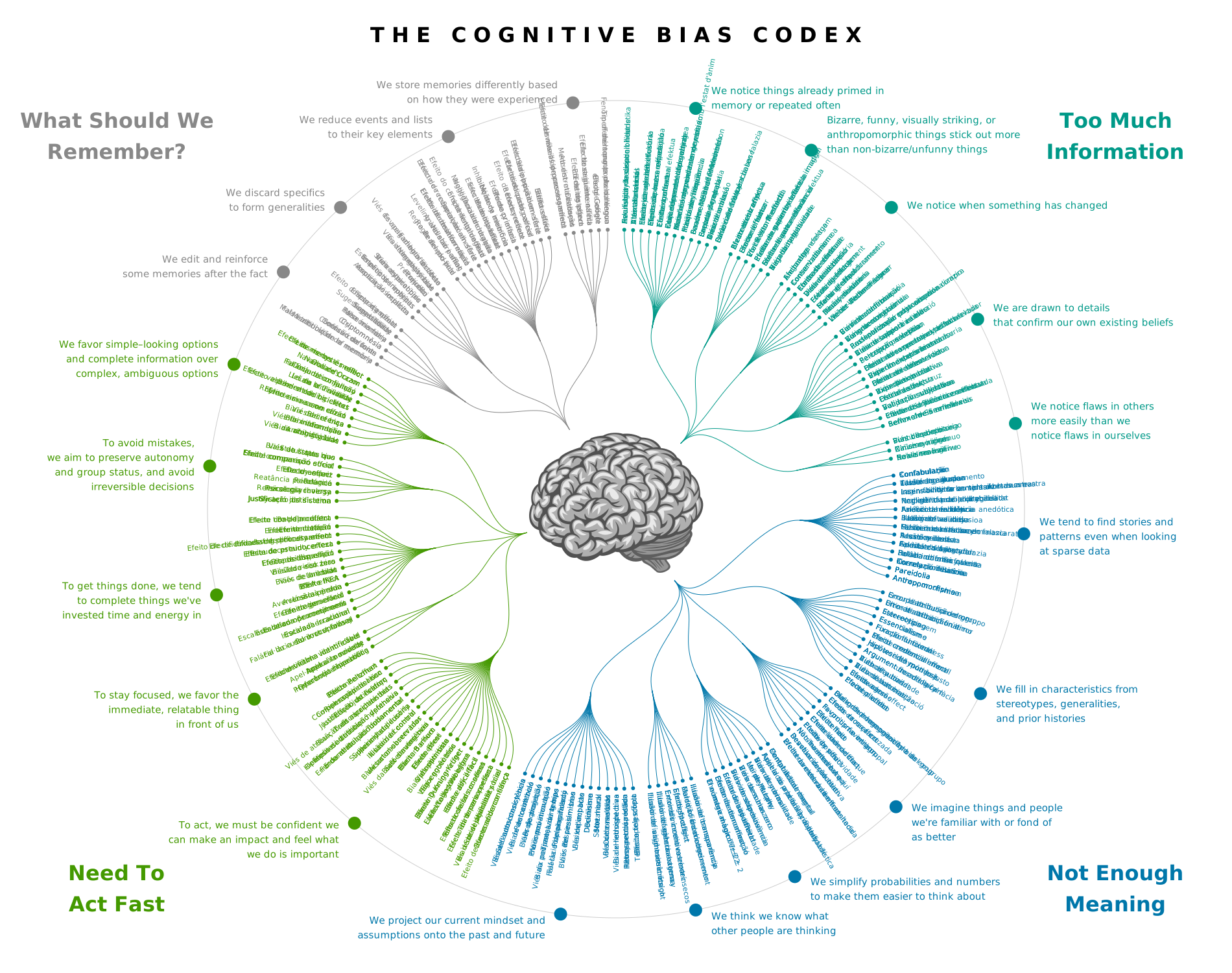
Cognitive bias codex from wikipedia
Cognitive biases are accompanying us throughout our live. Be aware of them, they trap us very often! In our case we already spoke about some attention span range of X seconds. It is very likely that you expected a result from the test in seconds, as we spoke about it before (my anchor for you). My Attention score based on the test from psychology today was 71, a quite good result. But despite numbers, the truth is more simple: could there be a universal number for an attention span at all? I say no.
If you look at your result, the test also classifies what "attention-span" means: Attention span refers to the amount of time we can focus on a task before we start to 'zone out'. This is the starting point of the real issue the goldfish metaphor has.
What is attention span at all?
Despite the mentioned definition of the attention span, attention depends on other factors, such as age or the typ of attention, whether it be transient, selective or focused attention. Moreover it’s about the context in which we speak about the attention. In case of the microsoft study from 2015, the result referred to how long people looked at websites while browsing. If you search the study for the word “goldfish”, you will find it once. On the graphics being used.
So what was the problem? An issue of communication design maybe. The designer translated a picture with wrong “facts”. Or if you dive deeper into the studies, there’s some hint that the dataset being used is even older (from 2008) or even wrong. See this source which also goes deeper into the classification of attention types. If you still don’t believe it, maybe BBC is a more trusted resource for you with this article.
Hopefully you already reached your point thinking, true... how should it be possible to claim that human attention is shorter than the one of a goldfish? 8 seconds during teaching classes sounds like nothing... or why should anyone watch a TED talk which lasts exactly 18 minutes? Was all the underlying neuroscience lying to make it exactly 18 minutes?
I would even assume a goldfish has different attention spans, depending on the situation.
The whole 8 seconds myth and the goldfish is an example of the destruction of our beautiful worldwide web. It’s maybe another rebound effect (I wrote about rebound effects in terms of UX) in this case marketers created. Snackable content formats got promoted over the years after the goldfish myth got more popular and so another industry was created. Snackable contents were the answer to the myth. They were created to get consumed easily in the attention consuming industry of the social media networks.
Looking at own website analytics data, marketeers got an early understanding that the time spend on a site is far longer. Even if you control your data with eye-tracking or other research based tests, there was never a room for a 8 second myth. And even if we speak about websites and attention, it depends on the website itself. Whether it be an article, a routing site, an interactive format,... Sure there are things that could be decided in a span of some short seconds. Maybe the aesthetic-usability effect is one of those. But it wasn't evaluated in seconds, as it depends on the context and other relevant influences.
Why do we want to believe in the myth of the goldfish?
Maybe because we feel that something changed. The rise of the web 2.0 and social media did good in destroying our ability to concentrate. Mostly our focused attention is suffering.
Please read this article on “your attention didn’t collapse. It was stolen.”

I personally hope for a better Search. Google, please fix your search! Otherwise you might end up dying.
And dear readers, believe in your attention span. If you ended down here you must be a grandmaster of attention. Thank you!

This Article was mentioned on manfred-feiger.com