In my last article, I set the stage for the beauty of "what if". Now, I want to dive a bit more deep to show why "what if" thinking will help us in design in general.
The Human Factor in Digitalization is you (as a designer)
So for all being worried about their jobs being done by AI, “What if” has some magic, that could give you many interesting options for potential needs in the future.
Why is that? Let’s put it simple: We have many realms in our lives, where we started to digitalize. The experience of digitalization is not always positive. If the human factor is missing, a lot of things get more complicated for certain kind of user groups. Taking the next step towards AI integration may improve access to advanced digitalization, as AI agents or chatbots can effectively mimic human behavior. However, it is important to note that this is not necessarily guaranteed to happen.
This is a hypothetical question: What if AI integration is increasingly impacting various aspects of our lives? There appears to be a significant demand for professionals in the Human Interface field, often referred to as HCI (Human-Computer Interaction) in academic contexts, as well as in UI or UX design in the industry. The same holds true for emerging technologies like brain-computer interfaces. There are countless exciting job opportunities, particularly for designers, who are crucial in enhancing human interactions with these innovative systems.
The work of many individuals in that area may need to transition from design aesthetics to emphasizing the fundamental aspects of HCI and UX. This approach involves a human-centered process that prioritizes understanding, observing, testing, and iterating.
Future Scenario Development and Speculative Design Techniques
Let's dig in a little and talk about something I assigned as a project for a master's course. What if we could generate all digital environments in real time? I included a link to a paper on "Oasis: a universe in a transformer," which is like a Minecraft game that generates gameplay in real time.
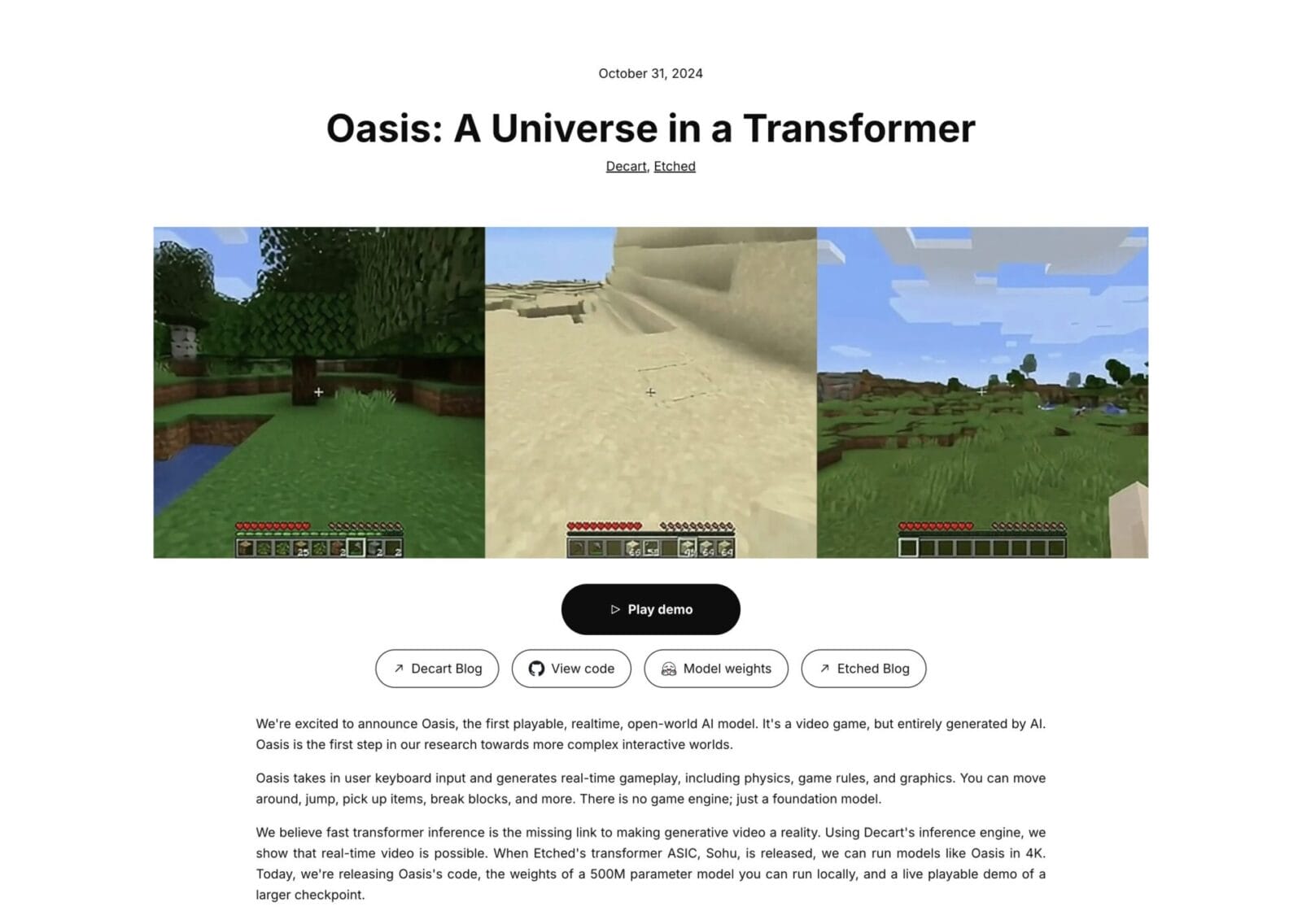
So let's dive deeper into that idea. Feel free to think about this world and ask yourself a more specific question like, "How can we crawl the internet when content is generated in real time?" That's the exact example I used for the assignment. The trick is to narrow down the future perspective to a certain topic. When working on solutions for sustainable development goals (which also comes up in other classes with students), it's also important to focus. In this case, the trick is to identify smaller pieces of the overall problem and come up with good ideas and solutions. Or as Charles Eames said:
Here is one of the few effective keys to the Design problem: the ability of the Designer to recognize as many of the constraints as possible; his willingness and enthusiasm for working within these constraints. Constraints of price, of size, of strength, of balance, of surface, of time, and so forth. Each problem has its own peculiar list.“
Charles Eames, Design Q & A (1972); watch video
When developing ideas, having restrictions or constraints is crucial. This mirrors the experience of working on client projects, where creativity often flourishes by challenging norms and breaking expectations.
Extending and combining "What if" questions
Let’s delve deeper into our real-time creation scenario. Imagine the possibilities! While computer games or films might be generated in similar ways as now, when we use text-to-image generators or hopefully in a much more human/intuitive way, let's shift our focus back to the web for now.
In my example for the students, I introduced an additional "what if" scenario alongside the initial one, as it captivated my interest: What if each individual had a personal digital AI agent tailored specifically to their interests, usage patterns, and unique configurations?
In my point of view, it is also a nice hypothesis of the close future. Both what if questions could be combined to a new “How might we question” again, such as “How might we crawl the internet, when contents are being generated in real time based on my personal interests?”
This is the general approach. Being a designer it feels a bit more interesting, how this media might look and feel like, so instead of “How might we”, one could also use “What might the NAMEIT magazine might look like, when contents are being generated in real time based on my personal interests?” to make the question more precise.
I guess you get the idea.
What might magazines look like, when contents are being generated in real time based on my personal interests?
As a designer specializing in digital media, numerous sub-questions and hypotheses regarding this future scenario will naturally arise. To help you engage with my thought process, here are some concise bullet points of varying complexity that directly came to my mind:
- What about branding/identity?
- Mustn’t it be much more scalable, responsive, adaptive?
- Will branding die or do we need more flexibility in the current systems? something like advanced flexible visual systems
- What if branding gets lost, looses its meaning?
- Wouldn’t authenticity in general be endangered?
- What about our own identity? Or is it about identity as a whole? Would such a scenario might lead to a new question about the true impact of automation on our lives?
- How would the role of the editors of a magazine change, and how is their job profile changing in general?
- What about problems such as the filter bubble, if we always have this pre-assembled contents? Wouldn’t AI be able to manipulate us in an easy, subtle way? What if this generated world is also enriched by AI-generated content?
- What needs to be done on the content level to be able to provide the contents in a suitable way?
- What does real time really mean? would only the interface be real time? or could old websites with unstructured contents also be transformed in real time? What about the latencies?
- How would free exploration without my agent feel like?
So those are only some quick questions around that scenario that quickly came to my mind on different scales. At first all around the world of branding, then changed roles for users and producers, also the role of AI and pre-assembled contents feels interesting. But also the “realist” perspective, of what could be done, also in the present, to prepare the content to allow such a future.
I could passionately explore this topic or example for hours, but first, I’d like to provide an in-depth introduction to the concept of "what if" thinking.
Changing perspective, taking a position
We have the opportunity to explore a multitude of perspectives and ideas regarding future scenarios. To enhance our discussion, consider organizing your thoughts around distinct core perspectives: the innovative perspective, the critical perspective, and the speculative perspective — this is my preferred framework. This approach is also featured in the highly recommended book "Designing Futures" by Benedikt Groß and Eileen Mandir. Furthermore, the inclusion of a pragmatic cluster could also be beneficial.
By taking a perspective or doing some clustering one could also work with own emotions to see what future is most desirable for oneself. So in terms of the mentioned branding challenge one could focus on innovation and show how one design language adapts to different target audiences, whether it be age, cultural background or whatever other metrics that looks promising for you at that moment.
Or if you want to be critical, you could show a picture of branded contents in another surrounding (to give you a corporate website example… maybe someone configures the own AI agent with a preference for apples design, so the general visual display of information might feel apple like… so what does booking.com or the Deutsche Bahn look like in an apple setting? By generating a critical picture we enforce more critical thinking around this potential future and like this we might be able to create a discourse.
Envisioning futures
Applying "what if" thinking is a door opener to 21st century design, to our own future being designer and a great way to get out of the dullness one might experience in the daily routine of the job.
I would encourage everyone to regularly practice "what if" thinking, as this creative exercise can break the monotony of routine tasks, which are the most susceptible to automation and least conducive to fostering creativity.
Applying "what if" also helps to consider the ethical implications of such "what if" advancements. As designers, we are tasked with ensuring that our creations foster inclusivity and accessibility while protecting individual identities. The questions raised in this article serve as a reminder of the delicate balance we must strike between innovation and responsibility on the one hand, but also on our role in the future being a designer. Maybe we discover new areas of action, maybe we develop a responsive design 2.0 whatever it be named framework to be ready for the future of scalable brands or we initiate or foster an early discussion about potential dangers.
In the headline for this subchapter I used the word envisioning. Envisioning is a strong concept for all humans, as it supports our goal setting, motivation and creates an emotional connection to the visualized goal. Incorporating envisioning in a business setting and in our design practice might bring similar benefits to our routines. Also in design, envisioning futures helps us to transform aspirations into reality if we aim for innovative solutions. Or it helps us to ignite a dialogue, a discussion about futures that might be harmful.
Finally it is our human factor in design that is essential to be prepared for the future and for the now. But most of us need to shift their perspectives. It also think mostly like a problem solver (as you might have read on this site, when I describe myself). As John Maeda said in 2009: Design ia solution to a problem. Art is a question to a problem.
I would extend it much more now (but still call me a problem solver):
Design is the art of understanding our constructed world, solving present problems, and anticipating future challenges.
Manfred Feiger (2025)